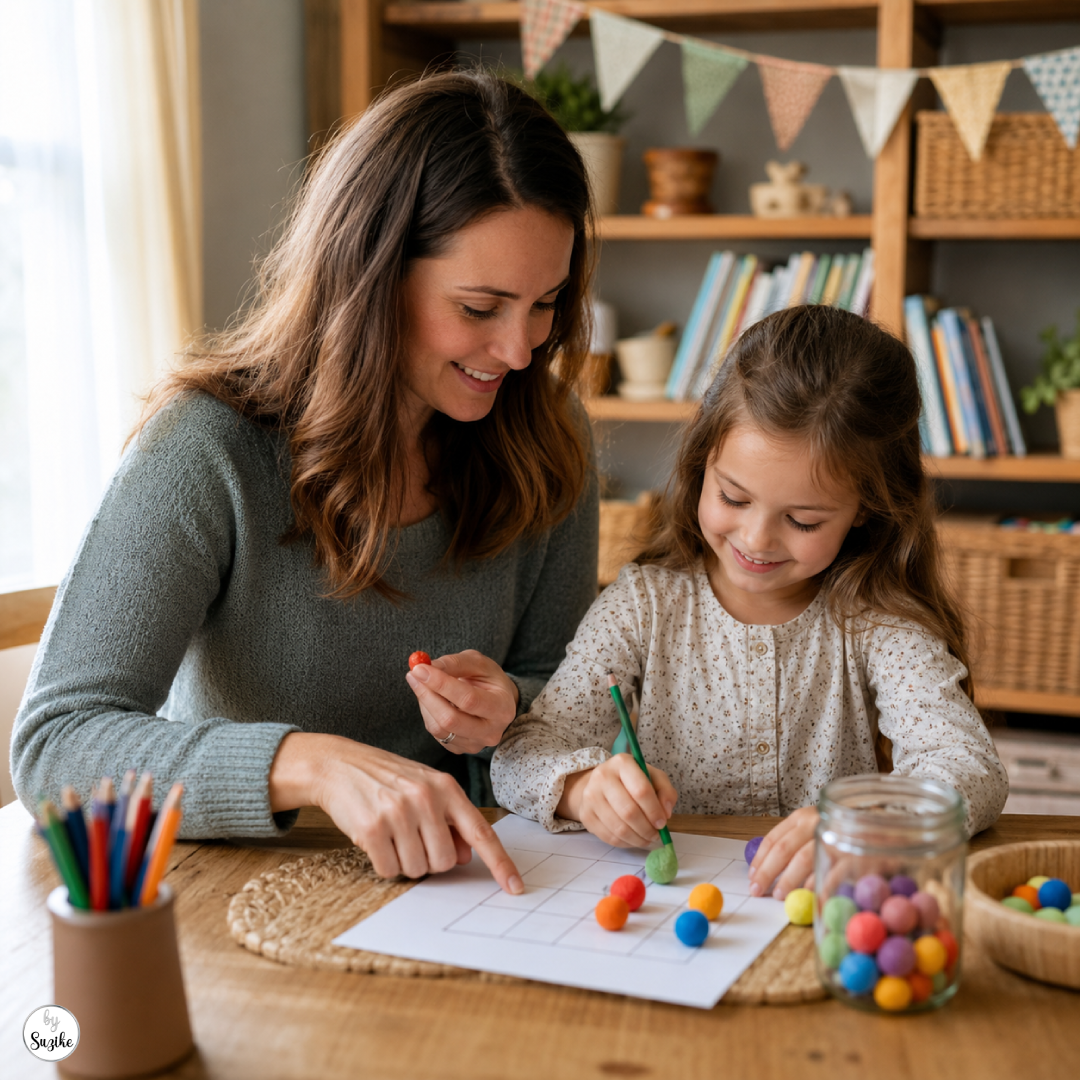
Teach Math Without Textbooks can feel intimidating at first, especially if you grew up believing math only “counts” when it happens on paper. In our home, I learned the opposite. The moments that stick are the ones that happen while you are living your day: measuring ingredients, comparing prices, counting steps, noticing patterns, and making quick decisions together.
If you are teaching at home, supporting school learning, or simply trying to make math less stressful, these ideas help you turn ordinary routines into real practice. You do not need a perfect plan. You just need a few repeatable ways to bring numbers into your week in a calm, practical way.
Cooking and Baking
Cooking is one of the easiest ways to build math confidence because the numbers are already there. Let your child measure ingredients, halve or double a recipe, and notice how fractions show up in real life. Even small moments, like setting a timer or dividing portions, train number sense without making it feel like “work.”
Shopping and Budgeting
Shopping turns math into decision making. Give your child a small budget and a simple goal, then compare prices together and talk through the choices. We do this in a very relaxed way, and it naturally brings in addition, subtraction, estimation, and unit pricing. If your child is older, this is also a gentle place to introduce taxes, discounts, and planning for monthly expenses.
Board Games and Card Games
Board games build math skills through repetition and strategy. A game like Monopoly supports money management, Yahtzee trains probability thinking, and Uno reinforces number recognition and sequencing. Even a basic deck of cards can become a quick routine that practices addition and subtraction while your child stays engaged because the goal is to play well, not to finish a worksheet.
Outdoor Math Challenges
Outdoor walks and everyday movement are full of math. Count steps, estimate distances, compare speeds, and set small “measurement missions” along the way. Chalk games also work beautifully for hopscotch style number patterns. When kids spot shapes in nature, measure a bench with footsteps, or guess the height of a tree, they are practicing geometry and estimation in a way that feels natural.
Building and Engineering
Building projects train spatial reasoning, symmetry, measurement, and problem solving. Lego, puzzles, and simple DIY challenges create a strong math foundation because kids have to plan, adjust, and test ideas. You can make it concrete by asking your child to build a bridge that holds weight or to design a shape pattern using specific lengths and angles.
Want a simple hands on example of math in action? Watch my 3 minute video lesson: Teach Addition with Math Cubes.
Real-Life Problem Solving
Real life questions create real motivation. Ask your child to calculate how long a trip will take, how many cups of paint a wall might need, or how many plates you need for a small family gathering. These tiny challenges build confidence because the answer matters to the moment, and the child can see the outcome immediately.
Music and Rhythm
Music supports math through rhythm and patterns. Clapping beats, counting in sets, and repeating sequences helps kids understand fractions and timing without formal explanations. You can create simple rhythm challenges together and vary the beat to practice counting, grouping, and pattern recognition.
Online Interactive Tools
Online tools can be a strong support when you use them with intention. Short sessions with platforms like Prodigy, Math Playground, or Khan Academy can reinforce skills your child is already practicing in daily life. The goal is consistency and confidence, not long screen time blocks.
Art and Patterns
Art is a natural bridge into geometry and patterns. Have your child create symmetrical drawings, explore tessellations, or measure angles while sketching. Pixel art is also great for grids, coordinates, and visual multiplication thinking, especially for kids who learn best through visuals.
Story Problems and Puzzles
Story based problems help math feel meaningful. Create small scenarios your child can solve, such as planning a snack tray, splitting items evenly, or organising a mini treasure hunt with number clues. Puzzle style challenges also work well, including scavenger hunts that require measuring, counting, and logical steps to reach the next clue.
Wrapping Up
Teach Math Without Textbooks becomes much easier when you stop trying to “create lessons” and start noticing what your week already contains. Math lives inside meals, errands, games, walks, music, and small decisions. Pick two or three ideas from this post and repeat them for a week. Confidence grows through calm repetition, and the learning starts to feel effortless because it is connected to real life.
Teach Math Without Textbooks: Quick FAQs
Can you really teach math without textbooks and still cover the basics?
Yes. You can teach math without textbooks through everyday activities that naturally build the same core skills: number sense, operations, measurement, problem solving, and patterns. The key is consistency. A few short, repeated check-ins each week often land better than long worksheet sessions.
What if my child needs structure and I worry that hands-on learning is too loose?
You can keep structure while still teaching math without textbooks. Pick one focus skill at a time, set a simple weekly rhythm, and repeat it in different contexts. For example, one cooking activity for measuring, one shopping activity for budgeting, one game for number practice, and one outdoor activity for counting and estimating.
What are the best math resources to support teaching math without textbooks at home?
Start with simple manipulatives and everyday materials: dice, cards, coins, measuring cups, building blocks, and a small whiteboard. If you want digital support, a short daily practice can help, especially when it stays connected to real-life situations. Khan Academy is a solid option for quick practice, and you can pair it with your hands-on activities so the concepts stay concrete. You can also try my addition activity here: Math in Minutes.
Leave A Comment