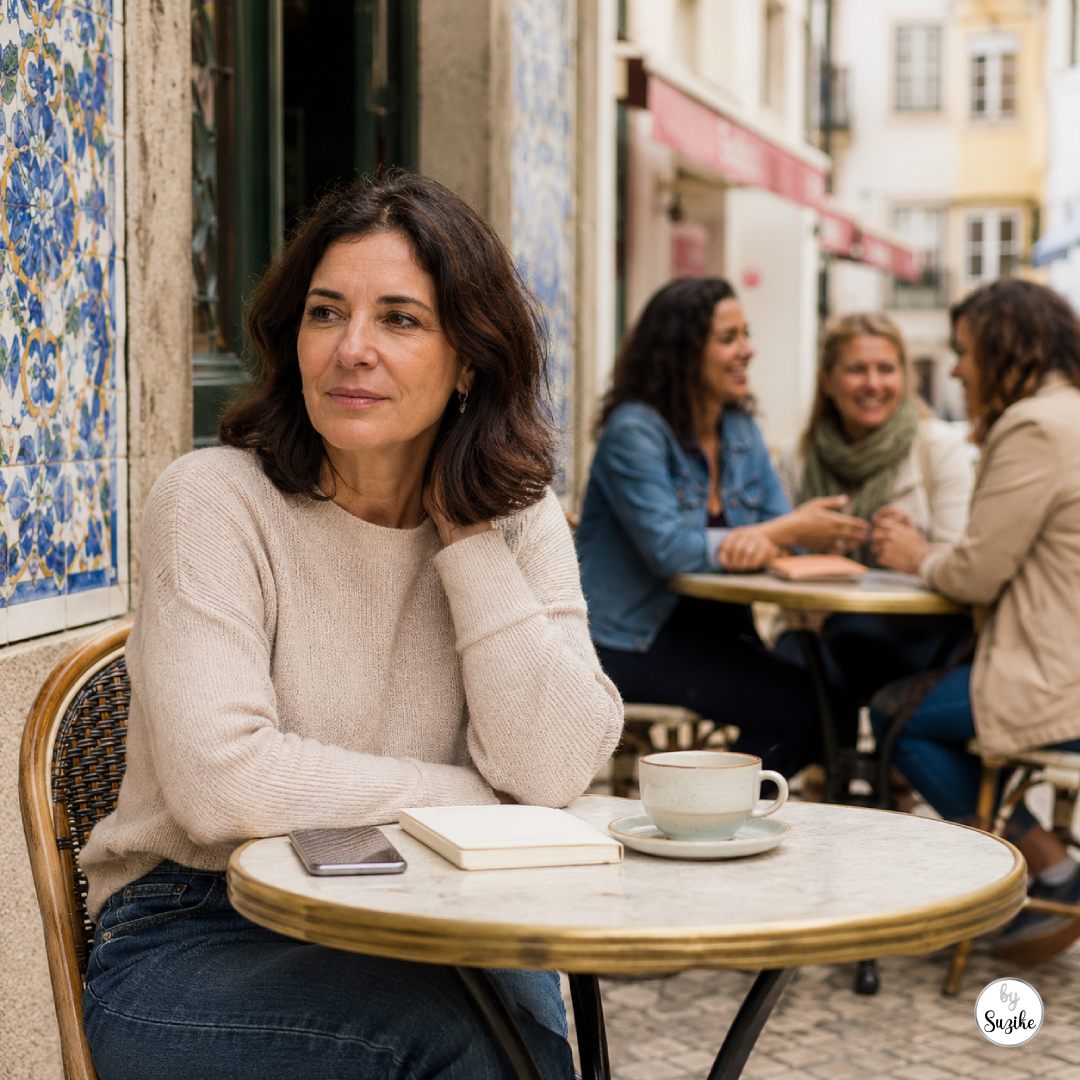
If you are wondering how to make friends in Portugal after 40, the honest answer is that it can feel surprisingly strange, and surprisingly lonely, even when life around you looks perfectly fine on the outside.
Portugal can be warm in many small, everyday ways. People say bom dia. The woman at the café may remember your coffee order. A neighbour might smile at you in the lift. Someone in the supermarket queue will make a comment about the weather, the price of tomatoes, or the absolute theatre of waiting forever at the till.
There are small moments of human contact everywhere.
And yet, at the end of the day, you can still go home and realise that none of those small conversations have become an actual friendship. Nobody has messaged. Nobody has invited you for coffee. Nobody really knows what your day looked like, what you are carrying, or how lonely life can feel when the house finally goes quiet.
That is the part people do not always say out loud.
Why Making Friends After 40 Feels Different
Making friends after 40 is different because life is already full. People have routines, families, marriages, children, ageing parents, jobs, old friends, old wounds, habits, and their own private little worlds. There may be real kindness around you, but kindness does not automatically turn into connection.
School, university, shared flats and first jobs created friendships almost by accident. There were people everywhere and time felt endless, even when you were broke, dramatic and completely convinced you were already exhausted by life.
Cute. We knew nothing.
Adult life is different. Time is tighter. Energy is more selective. After 40, many women no longer have patience for loud nights, forced networking, fake enthusiasm, or conversations that feel like emotional admin. There is also something else that happens at this age: we become less available for friendships that cost too much. That is a good thing. It also changes the game completely.
When you are no longer willing to entertain every connection just to avoid being alone, friendship becomes more honest. It also becomes slower. A new friend has to feel right. The energy has to feel safe. The conversation has to have some kind of ease from the beginning.
The Portugal Factor: Why Connection Here Takes Time
If you are living in Portugal as an expat, returning after years abroad, rebuilding life after a relationship ended, working from home, raising children, or simply entering a new phase where your old social circle no longer fits, making friends in Portugal after 40 can feel much slower than expected.
Portuguese social circles can be close and long established. People may be polite, friendly and genuinely helpful in everyday life, while deeper friendship still grows slowly and carefully. That can be disorienting if you come from a culture where people invite each other out quickly or where casual social plans happen more easily.
Friendship here tends to grow through familiarity, repetition and time.
You can speak to parents at children’s activities, go to appointments, walk through busy streets, sit in cafés and attend events, and still feel completely socially empty. Contact is easy. Connection takes more.
The strange emotional gap this creates is real. You can enjoy the light, the food, the slower pace, the cafés, the sea, the old streets, the warmth of small daily interactions, and still have days when you miss having someone who actually knows you. That is the difference between liking a country and feeling socially rooted in it.
Can Language Exchanges Help You Make Friends in Portugal?
Language exchanges can be genuinely useful, especially in Lisbon and Porto, because people arrive already expecting conversation. That removes some of the awkwardness immediately.
You are standing in a space where talking already has a reason to exist. You can practise Portuguese, help someone with English, ask where someone is from, laugh at pronunciation, talk about daily life, and leave without feeling like you had to perform.
Will every language exchange lead to friendship? Of course not. Sometimes it is just one evening of slightly chaotic conversation and then everyone disappears back into the city. Sometimes it is useful simply because it gives the week one more human moment.
And sometimes you meet someone who also wants a coffee, a walk, a museum visit, or just another normal adult conversation in a week that has been too quiet. That is enough of a reason to go.
Can Language Exchanges Help You Make Friends in Portugal?
Language exchanges can be useful in Portugal, especially in Lisbon and Porto, because people arrive already expecting conversation. That removes some of the awkwardness.
You are standing in a space where conversation already has a reason to exist. You can practise Portuguese, help someone with English, ask where someone is from, laugh at pronunciation, talk about daily life, and leave without feeling you had to perform.
Will every language exchange lead to friendship? Of course not.
Sometimes it is just one evening of slightly chaotic conversation and then everyone disappears into the city. Sometimes it is useful only because it gives the week one more human moment.
And sometimes you meet someone who also wants a coffee, a walk, a museum visit, or simply another normal human conversation in a week that has been too quiet.
That is enough of a reason to consider it.
How Cultural Events Make Social Life Feel Less Pressured
Cultural events help because they remove the pressure to make friends directly. You are there for the music, the exhibition, the food, the festival, the book event, the neighbourhood celebration. The event gives the conversation somewhere to go naturally.
I like that. It feels less needy. Less forced. More human.
You can enjoy the event even if you do not meet anyone. And if a conversation happens, it already has a subject. The food. The queue. The music. The fact that nobody can find the entrance. The very Portuguese way an event can be both genuinely lovely and slightly confusing at the same time.
For women who feel socially rusty, this matters. After years of motherhood, work, emotional pressure, divorce, moving country, or simply carrying too much for too long, walking into a room with the specific mission of making friends can feel unbearable. Going somewhere because the event itself interests you feels much easier, and it works better too.
Making Friends as a Mother in Portugal After 40
Motherhood adds another layer to all of this. When you are a mother, social life has to fit around real family life. Children, meals, school calendars, transport, tiredness, appointments, homework, random emotional explosions, and all the invisible things that somehow always end up inside the mother’s head.
In Portugal, many mothers meet people through children’s activities, playgrounds, school routines, libraries, swimming lessons, workshops, birthday parties and local events. These places create contact. But contact between mothers can be complicated, because sometimes two women only share the fact that their children are in the same room. That can produce a pleasant conversation without ever becoming friendship.
And that is fine. Not every social interaction has to become something deep.
Sometimes a friendly conversation is still useful because it makes the day feel less isolated. Sometimes it is enough to speak to another adult who understands the logistics, the tiredness, or the absurdity of trying to answer an email while a child urgently needs a specific blue sock that nobody has seen since 2022.
Small connection still counts. I think we underestimate that more than we should.
Starting Over Socially Is Humbling, and That Is Allowed
Starting over socially as a grown woman can feel genuinely humbling. Nobody really prepares you for the moment you realise your old social structure no longer exists, or no longer fits.
Maybe you moved to Portugal. Maybe you came back after many years away. Maybe your relationship ended. Maybe your friends are in completely different life stages now. Maybe you work from home and the days pass mostly in silence. Maybe you simply woke up one day and realised that the life around you is functional, but not emotionally full.
That kind of loneliness is quiet. It is the kind that shows up when you have good news and do not know who to tell. When you want to go somewhere but are tired of going alone. When you see a group of women laughing together and feel, just for a second, that everyone else received a set of instructions you somehow missed.
Many women know this feeling. They just do not always name it.
I find this very real. And I think it deserves to be said directly rather than dressed up in something more comfortable.
How to Make Friends in Portugal After 40 in a Realistic Way
Learning how to make friends in Portugal after 40 is more practical than it sounds, and less romantic too.
It is about creating enough repeated contact for familiarity to grow. A local café used regularly matters more than a one-off networking event. A weekly fitness class can matter more than a large social gathering. A walking route, a library activity, a language exchange, a gym class, a volunteering project, a neighbourhood market, a regular cultural event. These are the kinds of spaces where repeated contact slowly turns strangers into familiar people.
The most realistic starting points are the places that already fit your actual life. If loud bars drain you, loud bars are the wrong place to look for the friendships you want. If you love books, culture, food, walking, fitness, language learning, museums, parenting spaces or quiet cafés, those are far more sensible places to begin. Friendship has to fit the woman you are now, with your real energy, your real schedule and your real limits.
Some connections will stay light. Some will disappear. A few, slowly, may become part of your real life.
That slow part can be frustrating. I know. But it is also how most honest adult friendships actually begin.
A Social Life in Portugal Does Not Have to Be Huge to Be Real
There is a lot of pressure around friendship now. Finding your tribe. Building community. Surrounding yourself with your people. It sounds beautiful. It can also feel like another task on the already impossible list of things a woman is supposed to manage gracefully.
After 40, I think friendship can be smaller and still be meaningful.
One woman you can message. One person who meets you for coffee once a month. One walking friend. One neighbour who notices if you have not been around. One familiar face at the gym. One person who makes Portugal feel a little less anonymous on the days when it does.
That counts.
And perhaps the most honest thing I can say about making friends in Portugal after 40 is this: it begins smaller than you expect, it grows slower than you would like, and it is worth starting anyway.
What has your experience been? If you are building a social life in Portugal after 40, or trying to, I would genuinely like to hear how it has been going for you.
Leave A Comment