Friendships after 40 can feel strangely complicated. Life is full, the phone still rings, people still exist around us, and yet real connection can feel harder to keep, harder to find and sometimes harder to trust.
I think about this more than I expected to at this stage of life.
When I was younger, friendship felt more spontaneous. People were around. There was school, university, work, cafés, nights out, long conversations that started from nothing and somehow lasted for hours. Time was not exactly abundant, but it felt more flexible. A friendship could grow inside ordinary days because life had more open spaces.
After 40, those spaces become smaller.
The day is already full before it begins. There are children, work, appointments, meals, school messages, laundry, bills, family responsibilities, health, tiredness, and all the invisible things women carry without turning them into public announcements. Social life becomes something that has to fit between everything else, and sometimes there is simply no room left.
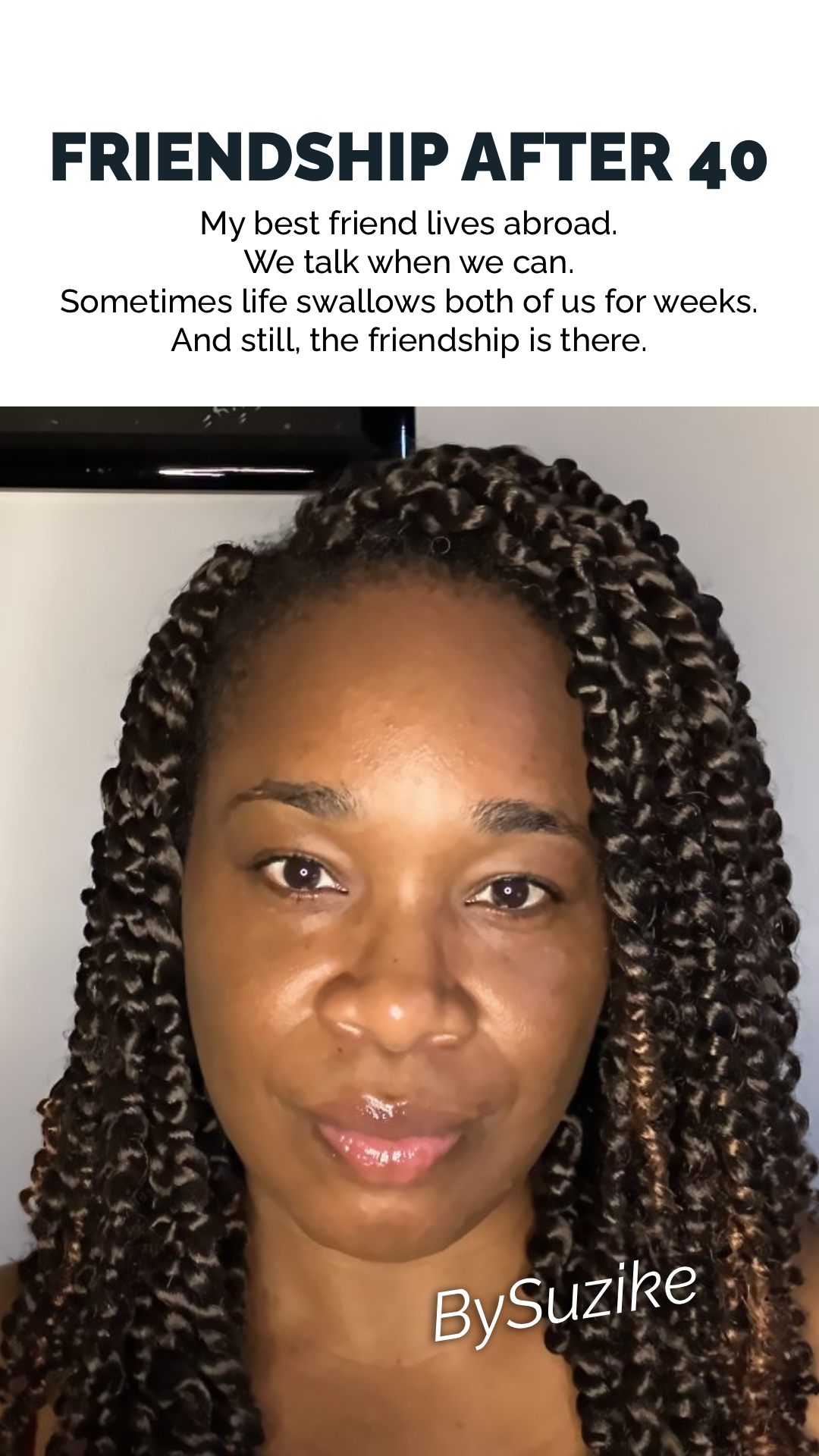
My best friend lives abroad. We still talk on the phone when we can. Sometimes we talk properly, sometimes we send messages, sometimes life swallows both of us for a while. We are both mothers, which means even a simple phone call can become a logistical event. There is always someone needing something, somewhere to be, something to finish, something that cannot wait.
And still, the friendship is there.
That is probably one of the things I value more now. The friendships that survive distance, silence, motherhood, tiredness and complicated calendars are not always loud friendships. They are not always visible. They are not always full of photos, dinners and constant updates. Sometimes they are a voice note after a long day. Sometimes they are a phone call squeezed between responsibilities. Sometimes they are just the comfort of knowing that, even if weeks pass, the connection has not disappeared.
Friendship After 40 Requires A Different Kind Of Space
One of the hardest things about friendships after 40 is that new friendships require something many women no longer have easily available: emotional space.
It is easy to say that we can always meet new people. In theory, yes. In real life, it is more complex.
A new friendship takes time. It takes attention. It takes repeated contact. It takes trust. It takes a willingness to let someone slowly enter your life. At 20, that may happen naturally because life places people in front of us every day. At 40, many women are moving through routines that are already packed and emotionally demanding.
There is also a different level of caution.
By this age, we know more. We have seen relationships change. We have lost people. We have been disappointed. We have probably outgrown versions of ourselves, and with that we may also have outgrown certain friendships. We no longer have the same patience for drama, competition, gossip, emotional confusion or relationships that feel like another unpaid job.
That does not make us closed. It makes us more aware.
A woman after 40 often knows the difference between company and connection. She may enjoy talking to people, being polite, seeing familiar faces, having conversations at work, at school gates, at the gym or in the neighbourhood. Still, that is not always the same as having someone who truly knows her.
That is the quiet part.
You can have people around you and still miss real friendship.
Read next:
Life Gets Full, And Social Life Gets Smaller
There is a very particular loneliness that can appear in midlife. It is not always dramatic. It does not always look like isolation. Sometimes it looks like a woman managing everything well from the outside while quietly realising that her social life has become smaller.
For mothers, this can become even more obvious.
When children are little, a lot of social life revolves around them. School events, activities, birthdays, playgrounds, other parents, group chats. There are people everywhere, but many of those connections are practical. They exist because the children are in the same place at the same time.
Some of those connections may become real friendships. Many do not. They are pleasant, useful, familiar, and sometimes genuinely warm, but they may stay inside that specific context.
Then there is the other layer: energy.
After 40, I think many women become more honest about how much energy they actually have. A dinner out may sound lovely, but by Friday evening the sofa looks like a spiritual experience. A long conversation may be needed, but the brain is already full. A new invitation may be interesting, but the calendar is laughing in the background.
This is where friendship becomes complicated. We may want connection and still feel too tired to build it properly. We may miss people and still postpone the message. We may care deeply and still need silence.
That combination can feel strange, especially for women who were once much more socially available.
Distance Changes Friendship, But It Also Reveals It
Having my best friend abroad has made me see friendship differently.
Of course I would love to have her closer. There are moments when a phone call is not enough. There are days when I would love a coffee, a walk, a proper conversation without looking at the clock, without checking who needs to be picked up, fed, helped or answered.
But distance also reveals something important. Some friendships survive because they are rooted in something deeper than convenience.
When someone is part of your life only because they are nearby, the relationship may fade when geography changes. When someone remains part of your life across countries, motherhood, tiredness and imperfect communication, there is something real there.
I no longer measure friendship only by frequency. At this stage of life, frequency can be misleading. Some people are constantly present and still emotionally distant. Others are far away and still feel close.
There is something comforting about a friendship where both women understand that life is full. No guilt. No performance. No need to prove affection every three days. Just the quiet knowledge that life is happening on both sides and the bond remains.
That kind of friendship feels very adult to me.
New Friendships Take Longer Now
Making new friends after 40 is possible, but I think it takes longer.
There is a slower rhythm to it. Trust does not happen immediately. Availability is not automatic. Compatibility matters more. Shared values matter more. Emotional maturity matters more.
At this age, a new friendship has to enter a life that already has history.
It enters after heartbreaks, disappointments, responsibilities, routines, children, work, maybe divorce, maybe grief, maybe moving countries, maybe caring for parents, maybe rebuilding identity. A woman after 40 is not an empty room waiting to be filled. She is already a whole house, with rooms, memories, locked drawers, open windows, unfinished corners and a lot of things she has had to carry.
So when someone new appears, there is a natural slowness.
There is curiosity, but also observation. There is openness, but also self protection. There is interest, but also the question of whether this person brings peace or noise.
That is another thing I think changes after 40. Peace becomes very valuable.
A friendship that constantly demands explanation, performance or emotional management becomes tiring very quickly. A friendship that allows honesty, humour, pauses, imperfection and real life feels much rarer.
The Friendships We Keep Become More Intentional
One thing I like about this stage of life is that friendship becomes less performative.
I do not need twenty people around me to feel socially successful. I do not need constant plans to prove I have a life. I do not need to be seen everywhere. I care much more about the quality of the connection.
There is a calmness in accepting that some friendships belong to past versions of us. Some people were important in a certain season. Some relationships faded because life moved. Some connections no longer fit the woman we became.
That can hurt. It can also be clarifying.
After 40, friendship becomes more intentional because time is no longer something we throw around carelessly. The people we choose to call, answer, meet, listen to and keep in our lives matter. There is less space for relationships that leave us drained, confused or diminished.
There is also more appreciation for simple, steady connection.
A friend who understands your life. A friend who does not punish you for being busy. A friend who can laugh with you about the absurdity of motherhood, ageing, hormones, work, laundry and trying to have a personality between appointments. A friend who does not need a perfect version of you.
That is gold.
The Quiet Loneliness Nobody Talks About Enough
The strange thing about loneliness after 40 is that it often arrives inside a busy life.
It may appear while cooking dinner. While driving. While folding clothes. While scrolling through old photos. While seeing other women apparently surrounded by friends. While realising that the person you would naturally call is in another country, another routine, another time zone, another season of life.
It is not always sadness. Sometimes it is just a quiet awareness that connection has changed.
I think many women feel this and do not say it out loud because it sounds ungrateful. We may have families, children, work, routines, responsibilities, maybe even people who love us. Still, friendship occupies a specific place. It gives a kind of recognition that is different from family, romance or motherhood.
A good friend sees the woman behind all the roles. That matters.
Especially after 40, when so much of life can become functional. Mother. Worker. Daughter. Partner. Ex partner. Caregiver. Organiser of everything. The person who remembers appointments, snacks, payments, clothes, forms, school dates, medication, birthdays and what needs to be bought before Monday.
Friendship can remind us that we are more than the person managing the list.
Maybe Friendship After 40 Is Slower, But Deeper
I do not think friendship after 40 is impossible. I think it asks for more honesty.
Honesty about time. Honesty about energy. Honesty about the fact that some friendships will be maintained through phone calls, messages and imperfect timing. Honesty about the fact that new friendships may need patience. Honesty about the fact that a smaller social circle can still be meaningful.
I miss the ease of younger friendships sometimes. I miss the spontaneity. I miss having more time for long conversations that did not need to be scheduled like medical appointments.
But I also appreciate the depth that comes with this age.
I appreciate friendships where there is no need to pretend life is lighter than it is. I appreciate women who understand complexity. I appreciate conversations that can go from children to ageing parents, from work to hormones, from money to dreams, from exhaustion to ridiculous laughter in five minutes.
That is the kind of friendship I value now.
Friendships after 40 may feel harder because life is fuller, trust is slower, and availability is more limited. But when the connection is real, it can also feel more honest than ever.
And maybe that is why I keep thinking about it.
Because in a life full of responsibilities, real friendship becomes less about constant presence and more about emotional truth. The kind that survives distance. The kind that survives busy seasons. The kind that still feels like home, even from another country, on a phone call squeezed between two mothers doing their best.