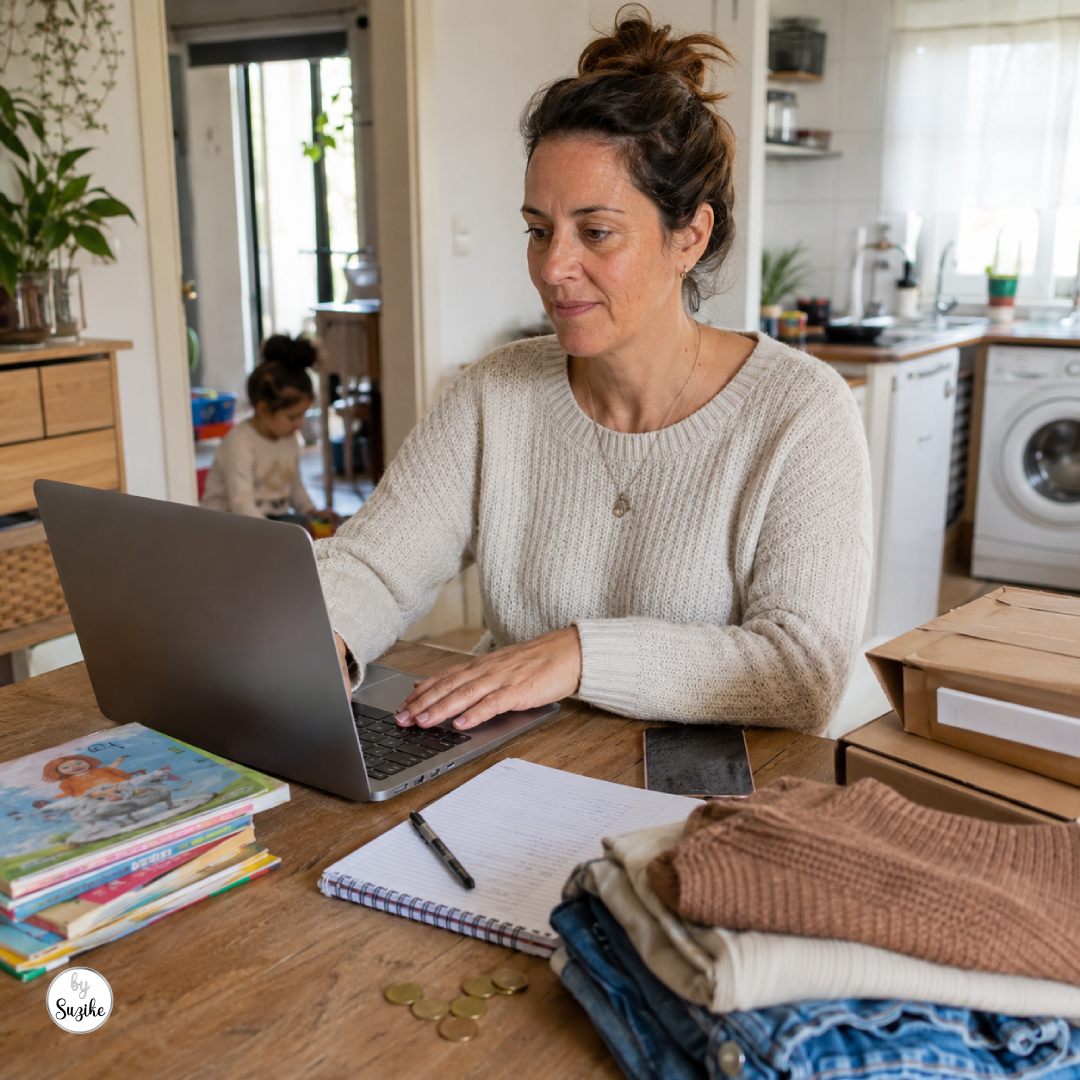
If you have been searching for how to make extra money in Portugal, I understand the feeling behind that search very well.
There comes a point when the normal monthly income starts to feel too tight for real life. The rent or mortgage is high. Supermarket prices seem to have developed a personality of their own. Children need things. The car needs fuel. The house always has one more expense waiting politely in the corner. And somehow, even when we are careful, the money disappears faster than expected.
I wrote more honestly about this pressure in my post about the cost of living in Portugal as a single mother, because extra income only makes sense when we look at the real monthly numbers behind it.
I am writing this as a woman over 40, a mother, and someone actively building a different kind of working life in Portugal. I am also writing it as someone who has looked around her own home and thought: there are things here that I no longer use, skills I can offer, ideas I can turn into products, and projects that can become income over time.
That is the real angle of this post.
This is not about pretending that making extra money in Portugal is effortless. It takes time, consistency and a practical mind. Some options are quick because they use what you already have. Others are slower because they involve building something with long-term value. For me, the most realistic approach is simple: start with what is already available. Things at home. Skills. Knowledge. Experience. A phone. A laptop. A small corner of the internet.
That is where extra income can begin.
In this article
- Why So Many People Are Looking for Extra Income in Portugal
- Start With What You Already Own: Selling at Home
- How to Make Extra Money in Portugal by Selling on Vinted
- Cash Converters, Wallapop and Local Resale Options
- Teaching and Tutoring: How to Make Extra Money in Portugal With Skills You Already Have
- Freelance Services From Home
- Selling Digital Products as Extra Income in Portugal
- Blogging: A Long-Term Way to Make Extra Money in Portugal
- Affiliate Marketing and YouTube
- The Skills Hidden Inside Ordinary Life
- Small Money Still Counts
- How to Choose the Right Way to Make Extra Money in Portugal
- FAQs
Why So Many People Are Looking for Extra Income in Portugal
Extra income has become part of real life for many people in Portugal because one salary often has to stretch across rent, groceries, utilities, transport, school costs and unexpected expenses.
For women over 40, mothers and single-income households, the question is often very practical: what can be done with the time, skills and resources already available?
That is the angle of this post. Realistic extra income in Portugal usually starts with ordinary things: items at home, existing skills, teaching experience, digital products, local services, content, affiliate links or small projects that can grow slowly over time.
Start With What You Already Own: Selling at Home
This is the most immediate option, and it is the one I would start with first.
I say this because I am doing it myself.
Over time, most homes collect things. Clothes we no longer wear. Children’s shoes that became too small. Books we already read. Toys that are still good but no longer used. Bags, coats, accessories, small electronics, school materials, home items, decorations, fitness equipment, and all those “maybe one day” objects sitting quietly in cupboards, boxes or garages.
At some point, I looked at all of that and thought: this is space occupied by money that is currently asleep.
Selling what you already own is one of the simplest ways to make extra money in Portugal because it does not require creating a new product, learning a new profession or investing in stock. The items are already there.
The first step is looking at your home with a more practical eye. What is still in good condition? What could help another family? What no longer fits your life? What has been sitting untouched for months or years?
For me, this has included books, children’s items, clothes, shoes and objects accumulated at home. Some things sell for small amounts. Three euros here. Five euros there. Ten euros if the item has more value.
Individually, that may not look impressive. Collectively, it can become useful.
And there is another benefit: the house starts feeling lighter. That matters too.
How to Make Extra Money in Portugal by Selling on Vinted
Selling on Vinted in Portugal is one of the most practical ways to turn unused items into extra income, and one of the platforms I use myself.
I wrote a full honest review of selling on Vinted in Portugal, including what actually sells, what takes work and whether I think it is worth it for small extra income.
I like Vinted because it is simple. You take photos, write a clear description, set the price and list the item. Buyers can search, ask questions, buy directly and use the platform’s shipping options.
It still takes work. Let us be honest about that. You need to photograph items properly, describe them accurately, answer messages, prepare parcels and send them. It is not passive income. It is active, practical, small-scale selling.
But it works well for the kind of items many mothers already have at home. Children’s clothes, shoes, books, toys, school items, baby accessories, women’s clothing and bags can all have a second life. Some things sell quickly. Others sit for a while. That is normal.
The key is to price with realism. When I sell things I no longer use, my goal is movement. I prefer a fair low price and a clean home to keeping everything stored forever because I imagined a higher price that nobody wanted to pay. That is a very personal choice. For me, space has value. Mental clarity has value. Money coming in, even in small amounts, has value.
You can visit my Vinted profile here if you enjoy second-hand finds, children’s items and practical everyday pieces.
Cash Converters, Wallapop and Local Resale Options
Another way to make extra money in Portugal is selling items directly to resale shops such as Cash Converters or similar second-hand businesses. This can be useful for electronics, watches, small appliances, music equipment, cameras, consoles and tools.
The main advantage is speed. You take the item, they assess it, and if they are interested, you receive money quickly. The disadvantage is also obvious: they need to resell the item, so the amount offered will usually be lower than selling directly.
For me, this option makes sense for items I do not want to photograph, list, explain, store or negotiate for weeks. Sometimes the convenience is worth accepting less.
For larger items, local platforms can also work. Facebook Marketplace is useful for furniture, children’s equipment and homeware. Wallapop may work for certain categories. Local Facebook groups can also move items quickly when the price is attractive.
The main challenge with local selling is communication. People ask questions. Some disappear. Some want discounts. Some say they are coming and never arrive. Deep breaths may be required. Possibly tea. Possibly stronger tea.
Still, for larger items where shipping is complicated, local selling can absolutely be worth the patience.
Teaching and Tutoring: How to Make Extra Money in Portugal With Skills You Already Have
One of the most sustainable ways to make extra money in Portugal is using a skill you have already developed.
Teaching is an obvious example. If you speak English, Portuguese, French or another language, online lessons can become a reliable source of extra income. If you have experience in education, tutoring can also work well. This may include school support, exam preparation, conversation lessons or adult learning.
This is especially relevant for teachers, former teachers, bilingual parents, expats, university students and anyone with a strong academic or professional background.
In my case, language teaching connects naturally with who I already am. I am a qualified teacher of Portuguese and English, I have lived and worked abroad, and I am building Lassyra around European Portuguese lessons for adults. That is an example of turning existing knowledge into a real income stream.
The advantage of tutoring is that it can start small. One student. One lesson. One package. One clear offer. The challenge is visibility. People need to know the service exists. A simple website, a clear booking page, a Facebook page or useful blog content can all help build trust over time.
For women over 40, this can be a very realistic path because it uses experience already earned over years and decades.
Freelance Services From Home
Freelancing is another practical option for people looking for extra income in Portugal, and one that often uses skills people already have without realising their value.
This can include writing, proofreading, translation, transcription, virtual assistance, social media support, Canva design, blog formatting, customer support, lesson planning, tutoring materials or admin tasks.
The mistake many people make is thinking they need to become a completely different person to earn extra money. Often, the income idea is much closer than it seems.
The question worth asking is: what do people already come to you for help with? What do you do faster than most? What have you learned through work, motherhood, life abroad, managing a home or building projects over the years?
That is where a freelance service can begin.
Selling Digital Products as Extra Income in Portugal
Digital products are one of my favourite long-term ideas because they can be created once and sold repeatedly.
This does not mean they are easy money. They are not. A digital product still needs a useful idea, a clear audience, good design, good copy, a sales page and traffic. Without traffic, even a good product can sit quietly online doing absolutely nothing. Ask me how I know. Actually, do not. I have already lived that lesson.
Still, digital products can become a strong income stream over time. Examples include planners, trackers, ebooks, meal plans, study materials, printable routines, educational resources, fitness logs, home organisation templates and language learning materials.
This is one area where mothers, teachers and women over 40 can have a real advantage, because we often have practical knowledge that comes directly from lived experience. A mother who has created routines for her child may turn that into a printable chart. A teacher may create study materials. A fitness enthusiast may create a workout tracker. Someone navigating life in Portugal may create practical guides for expats.
In my own case, I have created digital products connected with food, fitness, education and language learning, and you can find them at BySuzike Shop. Some ideas worked better than others. That is part of the process.
Blogging: A Long-Term Way to Make Extra Money in Portugal
Blogging can be a way to make extra money in Portugal, but it requires patience. A blog is not fast money. It takes time to write content, optimise posts, build authority, get indexed by Google, attract readers and turn that traffic into income.
However, blogging has one major advantage: a good article can keep working for months or years.
That is why I am investing so much energy into BySuzike. For me, blogging is not just writing personal thoughts online. It is becoming a practical content business. A blog can earn through display ads, affiliate links, digital products, services, newsletter growth and brand opportunities.
The key is writing content that people actually search for. A post about life in Portugal, saving money, motherhood, perimenopause, fitness after 40, school systems, supermarket routines or extra income can bring in readers with real questions. This article itself is part of that strategy. People are searching for how to make extra money in Portugal because they have a real problem. If a blog can answer that with useful, honest, experience-based content, it has a reason to exist and a reason to grow.
Affiliate Marketing and YouTube
Affiliate marketing can work well alongside a blog, YouTube channel, newsletter or social media presence. The basic idea is simple: you recommend a product or service, and if someone buys through your link, you may earn a commission.
For affiliate marketing to work properly, trust matters. The best affiliate links appear naturally in content where the product genuinely fits. A post about home workouts may include the mat or kettlebell actually used. A post about selling online may include packaging supplies. A post about cooking may include kitchen items from real recipes.
I prefer links that feel connected to real life. Women over 40 can smell the difference between a genuine recommendation and a desperate link placed there because someone heard affiliate marketing makes money. We can smell nonsense from another district.
YouTube can also become a source of income through ads, affiliate links, digital products and traffic sent back to a blog. For BySuzike, I see YouTube as a natural extension of the blog. A post can become a video. A video can send people to a product. A newsletter can bring readers back to the site. That is how small pieces start connecting into something larger.
The Skills Hidden Inside Ordinary Life
One thing I have learned is that people consistently underestimate ordinary skills.
Running a household requires organisation. Raising a child requires problem-solving. Teaching requires communication. Moving countries requires adaptation. Managing appointments, school forms, meals, budgets and daily routines requires actual executive functioning, even when nobody claps for it.
Many women have spent years developing genuinely useful skills without calling them skills. Planning. Teaching. Translating. Organising. Cooking. Budgeting. Researching. Writing. Designing simple materials. Explaining complicated things in simple language.
Those skills can become content, services, products or resources. There is a lot of value hidden inside a normal life. The question is whether we decide to use it.
Small Money Still Counts
I think this point matters, especially for mothers.
Sometimes we dismiss small amounts because they do not solve everything. Five euros does not pay the rent. Ten euros does not change a life. Thirty euros may disappear in one supermarket visit.
Still, small money counts. It creates movement. It proves that money can come from more than one place. It changes the energy from “I have no options” to “I can do something today.” That shift is more powerful than it sounds.
A few small sales can pay for fuel. A few more can cover school materials. A digital product sale can cover a subscription. A tutoring session can cover groceries. A blog post may bring traffic for months. None of these things need to be dramatic to matter.
This is also why the real cost of living in Portugal matters so much. Small amounts only look small until they are attached to actual bills, groceries, fuel, school materials and pharmacy costs.
How to Choose the Right Way to Make Extra Money in Portugal
The best approach depends entirely on your situation.
Time matters. Energy matters. Skills matter. Family responsibilities matter. The amount of money needed also matters.
Some people need quick cash: selling unused items is usually the fastest starting point. Some people want a flexible weekly income: tutoring, freelance services or local selling may work better. Some people want to build something long term: blogging, digital products, YouTube and affiliate marketing may make more sense. Some people need something simple because life is already full: in that case, starting with Vinted or Cash Converters is more realistic than trying to launch an online business.
There is no single perfect route. There is only the route that fits your real life enough for you to keep going.
My current approach combines several of these at once. I am selling things on Vinted. I am building BySuzike as a content business. I am developing Lassyra around European Portuguese lessons. I am creating digital products. I am exploring affiliate marketing. I am learning what works, what does not, what brings traffic and what deserves more attention.
Extra income is often a process of testing. Some ideas sound good and do not work. Some small ideas surprise you. Some things take longer than expected. Some income streams begin with tiny amounts and only become meaningful when repeated consistently.
The goal, for me, is real financial breathing room and a life with more flexibility and more control over my own time. That is the honest reason this Money and Real Life section exists on BySuzike.
This post is also part of my Life Tips in Portugal hub, where I gather practical posts about money, home routines, grocery shopping, family life and everyday systems after 40.
FAQs: How to Make Extra Money in Portugal

Leave A Comment