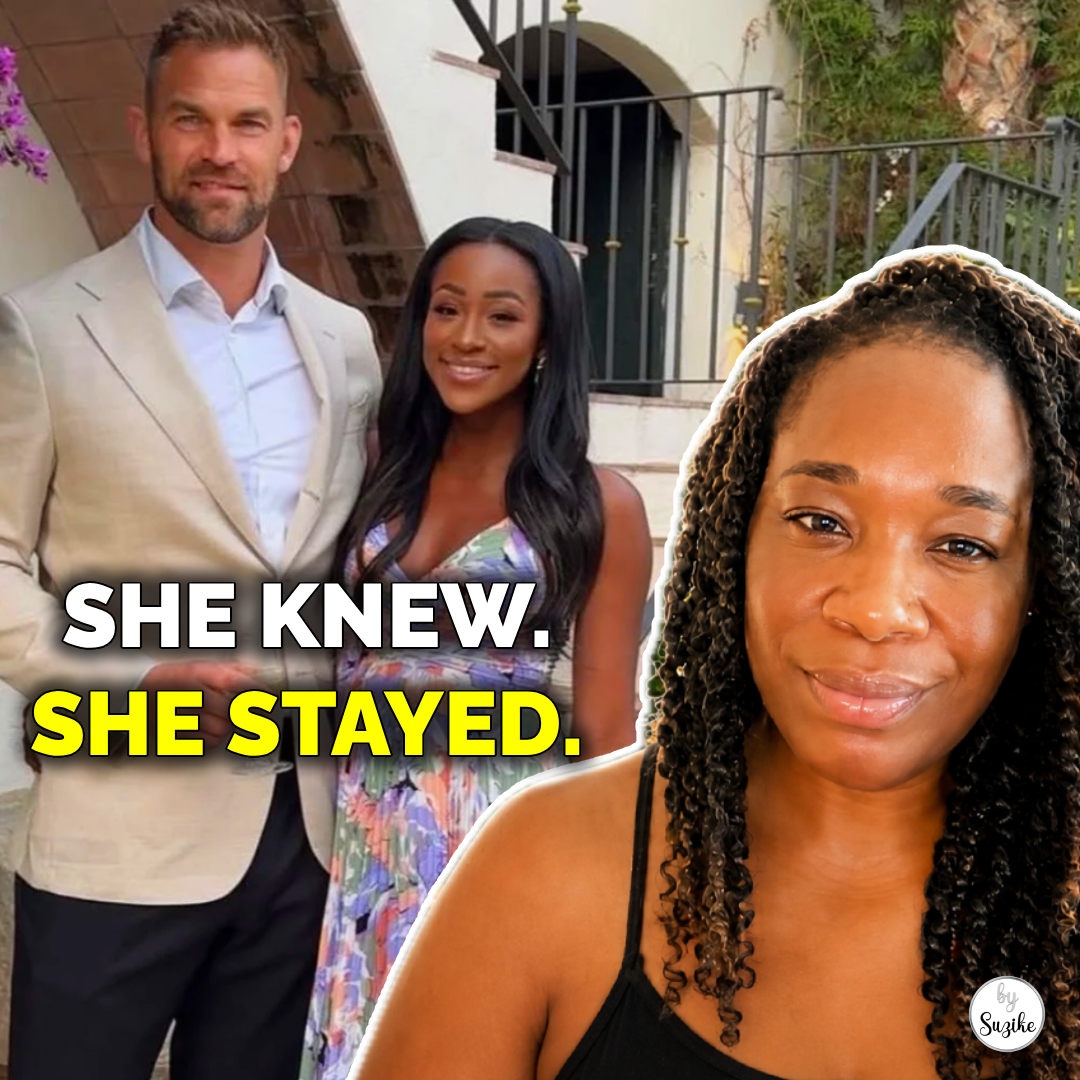
If you’ve spent any time on TikTok since November, you’ve probably run into some version of “The Danish Deception.” It’s the 25-plus part series where Bachelor alum Onyeka Ehie told the story of her marriage to a Danish man named Martin Fredsgaard Andersen, a man she says lied about his family, his wealth, his history, and eventually his loyalty. It became one of those internet sagas that everyone has an opinion on, mostly about him.
I want to talk about her instead. Not to blame her, and not to pile on. To actually look at her choices, the way we’d look at our own if we were brave enough, and ask what they can teach the rest of us.
Here’s the thing about this story that most of the recaps miss. It’s not really about a woman being fooled by a clever liar. Plenty of women meet clever liars and walk away in week two. What makes this story worth sitting with is how many times reality handed Onyeka another piece of information about who Martin actually was, and how many times she found a way to keep the relationship intact anyway.
They met on vacation in Croatia in the summer of 2022. He was attractive, attentive, and generous almost immediately. There were luxury trips, stories about royal connections and Olympic medals, a fast-moving romance that crossed an ocean. Eventually there was a marriage. And over the following years, piece by piece, a very different picture of who he was started to surface: gambling, debt, lies, people in her own life getting hurt.
I’m not going to hand you every twist right now. What I want to establish before we go any further is this: most of us will never meet a man who claims to be Danish royalty. But a lot of us have ignored something. Moved faster than we should have. Trusted before trust was earned. Explained away a behavior we didn’t like. Protected a man’s image in front of people who loved us. Believed in someone’s potential more than his actual pattern. Stayed, quite simply, because we wanted it to work that badly.
That’s the real subject here. Let’s go through it, one escalation at a time.
Mistake #1: She Trusted Him Before She Really Knew Him
Early on, Martin offered to fly Onyeka out for a luxury trip to Monaco. To book it, she sent him a photo of her passport, at a point when she barely knew him. She has also said she told him she was in love with him after three days together, during that same trip.
The passport itself isn’t what caused everything that came after, and three days isn’t a crime. What matters is how fast an expensive invitation, and an intense few days, made an almost-stranger feel safe to hand things to, information, trust, and eventually her heart.
Why does luxury do that to us? Because generosity reads as character, even though it isn’t. A five-star hotel and a business-class seat can feel like proof of who someone is, when really it’s only proof of what someone can afford, or is willing to spend, to get what he wants. A luxury invitation is not a background check. And intensity isn’t intimacy either, no matter how much it feels like it in the moment. Intensity is easy to manufacture: attention, romance, novelty, someone reflecting back exactly what you want to hear. Intimacy takes something intensity can’t fake, which is time, ordinary days, and seeing a person when nothing is being performed.
I want to sit with this a beat longer, because it’s easy to nod along and quietly assume it doesn’t apply to you. You may never hand a near-stranger your passport. But most of us have handed someone something equivalent early, an apartment key, a family secret, our actual schedule, because the treatment made it feel earned. It rarely is. It’s just fast. And this is where I think we sometimes fool ourselves: if you strip away the adjectives, generous, attentive, different, amazing, what do you actually know about this man at this point? Not how he made you feel. What he’s actually done, said, and shown you, in plain facts. If the feeling is doing more work than the facts can support, that gap is worth sitting with.
Mistake #2: She Fell for His Story Before Checking His Character
Martin arrived as a whole production: good looks, European charm, wealth, real estate, an Olympic backstory, a claim to Danish royal lineage. It’s worth asking, honestly, whether Onyeka was falling for him, or falling for the life that came stapled to him. That’s not an insult. It’s an incredibly common and human thing to do. Was she evaluating Martin, or was she evaluating how exciting a future with Martin looked from the outside?
This is worth separating out because the two questions get answers that look identical in the moment and completely different a year later. A man and a lifestyle can arrive as one bundle, and it takes real discipline to ask which part you’d still want if you subtracted the other. Would this still feel like love if the properties, the royal backstory, and the Olympic medals turned out to be an ordinary guy with an ordinary job? That’s not a hypothetical question in this story. It’s the exact question Onyeka eventually had to answer, just years later than would have helped her.
Wealthy, athletic, well-connected, successful. None of those words actually answer the only question that matters in a relationship, which is whether someone is honest, loyal, and reliable when nobody’s watching. Achievements are not character. Status is not character. Generosity is not character. Charm is not character. Character only shows up in what a person does, repeatedly, especially when it costs him something. We know this intellectually and still get tripped up by it constantly, because impressive things are loud and character is quiet. An Olympic story gets told at dinner in front of your whole family. Whether someone pays back a friend, or tells the truth when it’s inconvenient, takes months to accumulate and rarely gets mentioned out loud at all.
And here’s the part that stings a little: an Olympic history and a claim to royal lineage both leave a public trail. Onyeka didn’t dig into either early on, and a private investigator later confirmed there was no Olympic record to find. I’m not suggesting every early relationship needs a background check. I’m asking a more uncomfortable question: sometimes we don’t look something up because we’re not actually ready for what we might find. We want the fantasy confirmed, not the fantasy tested. Think about how rarely this instinct shows up anywhere else in life. Most of us will read every review before booking a hotel room, or ask three friends about a new dentist. Then we’ll meet a man with a genuinely extraordinary life story and somehow skip the version of due diligence we’d apply to a $200 purchase.
That is exactly how we can end up falling for the idea of a man instead of the man himself, especially when the future we imagine with him is more seductive than the reality we actually know.
Mistake #3: She Committed Faster Than She Was Learning Who He Was
Long distance turned into visits, visits turned into talk of marriage and a green card, all while most of what Onyeka knew about Martin’s actual day-to-day life in Denmark came from him. Commitment was growing faster than information. Romantic certainty can feel exactly like knowledge, even when it’s really just hope wearing knowledge’s clothes.
It helps to notice which milestones actually require knowledge and which ones just require feeling. Falling in love requires almost nothing except two willing people and some chemistry. Planning a shared country, a legal marriage, a merged financial life, those require you to actually know how someone handles stress, money, conflict, and boredom. This story moved several of the second category of decisions at the speed of the first, and that mismatch is where a lot of the damage started to compound.
Along the way, people outside the relationship kept surfacing the gaps more clearly than Onyeka could see them herself, precisely because they weren’t emotionally invested in the ending. Her own mother raised a simple, revealing question about whether Martin’s family even knew about her. That’s not an attack. It’s a flashlight pointed at a part of the story no one had looked at yet. Most of us, if we’re honest, have a version of this memory: someone asked one plain question about a relationship we were deep inside of, and we felt a flash of defensiveness before we felt anything else. If a simple, fair question makes you want to protect the relationship rather than actually answer it, some part of you already suspects the answer isn’t going to hold up.
They married at a courthouse months into a relationship still full of unanswered questions, and this is worth separating from just moving quickly. This is about using a legal, permanent commitment to try to manufacture the security that should have come first. Marriage should be the outcome of an already-established sense of safety. It shouldn’t be the mechanism you use to try to create that safety. This particular mistake is quietly common, even outside stories this dramatic. Plenty of women have gotten engaged or married partly hoping the commitment itself would settle doubts a longer courtship might have settled naturally. It rarely works that way. A wedding doesn’t resolve uncertainty about someone’s character. It just adds legal, financial, and emotional weight on top of whatever uncertainty was already there.
Mistake #4: She Started Explaining the Red Flags for Him
This might be the single most important idea in the whole story. When Martin’s stories didn’t line up, Onyeka has described finding ways to make sense of it herself, filling in the gap with a version that let her keep believing in him.
Sometimes a man doesn’t even need a convincing excuse. We write one for him.
This isn’t stupidity. It’s what happens when accepting reality would cost you something you desperately want to keep. At a certain point she wasn’t just receiving information about who he was. She was helping the story survive. And once you’re doing that work for someone, you’re no longer in a relationship with the man in front of you. You’re in a relationship with the version of him you’ve been quietly editing to make sense.
This is also how an unhealthy relationship can become difficult to recognize while you’re still inside it. Every explanation makes the next contradiction a little easier to tolerate.
Mistake #5: She Let Him Control the Version of Himself She Saw
As the relationship went on, people from Martin’s past, including a former partner, started appearing at the edges of Onyeka’s social media. By her account, Martin painted some of these people as difficult or unstable and encouraged her to cut them off, which she did. Later, some of those very people turned out to have real, important information, including about the true overlap between his relationship with Onyeka and a previous one.
Never let the person whose character is in question be the one who picks your witnesses.
Certain problems, by her account, were also kept from friends and family because Martin didn’t want to be judged, and Onyeka accepted that secrecy. That’s not really about privacy. It’s about removing the outside reality checks that might have interrupted the story early. Between choosing her witnesses and controlling what her own circle got to see, Martin wasn’t just presenting himself to Onyeka. He was managing the entire supply of evidence she had access to. If telling the truth about your partner would make the people who love you think less of him, the honest question isn’t whether they’d overreact. It’s whether his behavior deserves the reaction.
Mistake #6: She Ignored What Money Revealed About His Character
A rotating cast of financial crises, a property deal, frozen funds, a family debt, kept requiring Onyeka’s money, even as Martin continued to present himself as wealthy and successful. The lesson here isn’t “never lend a partner money.” It’s this: at what point does a repeating contradiction stop being a string of bad luck and become information about the person creating it?
It got more serious from there. At some point, Martin reportedly borrowed money from people in Onyeka’s own circle, not just from her, which changes the shape of the problem completely. This was no longer only her risk to take. People trusted him partly because they trusted her, which means his behavior was now spending her credibility, not just her money. By her account, he took a significant amount from people close to her and never made them whole, and that fact alone should have changed how she saw him. Instead, the relationship continued, and by her own telling, she kept trying to repair the marriage, protect it, and build a future with him.
I want to be precise about where the real issue sits, because it’s not “she stayed in a relationship with debt in it.” It’s this: these were her people. They trusted Martin partly because they trusted her judgment. Once she knew the man beside her had seriously harmed people who loved her, continuing to treat him primarily as “my husband who needs help,” rather than asking what this actually revealed about his character, is a choice worth sitting with honestly, not excusing and not shaming either.
There’s a trap hiding inside this one that’s worth naming directly: it’s possible to mentally split “the man who’s wonderful to me” from “the man who is hurting people around me,” as if they’re two different people. They’re not. How a man treats other people, especially people who trusted him only because they trusted you, is some of the clearest information you will ever get about how he’ll eventually treat you. What does it say about a man when he’s willing to spend your relationships, your reputation, and the goodwill people have toward you, as if they were his own resources? By her account, that’s exactly what happened here, and it kept happening because she kept absorbing it instead of naming it.
Because love without respect is not enough to build a healthy relationship. Respect also shows in how someone treats the people you care about, not only in how lovingly he treats you.
Mistake #7: She Gave Up Pieces of Her Own Independence for the Relationship
By her account, Onyeka stepped back from her own financial and professional footing at points in the relationship, trusting that Martin’s stability would cover the gap. This isn’t really about income. It’s about outsourcing your own security to someone whose reliability hasn’t actually been proven yet. Don’t dismantle your own stability because somebody promises to become it.
This is one of the quietest mistakes on this whole list, because it rarely feels like a mistake while it’s happening. It feels like trust. It feels like commitment. It feels, honestly, like the kind of leap romantic comedies tell us to admire. But stability you’ve built yourself, a job, savings, your own name on the lease, is not just financial. It’s also the floor that lets you leave a relationship if you ever need to. Handing that floor to someone else’s promise means that if the promise doesn’t hold, you’re not just disappointed. You’re stuck.
Mistake #8: She Turned His Problem Into Their Project
Around the holidays, a friend close to Martin warned Onyeka about a past gambling addiction. Martin framed it as old news, something he’d overcome years earlier, and she accepted that. It’s worth noticing the pattern here, because it repeats in a lot of relationships, not just this one: serious warning, comforting explanation, relief, back to normal. The healthier version is serious warning, then verify, observe, and reassess, rather than simply feeling grateful for the reassurance.
When it became clear the gambling wasn’t safely in the past, by her account a friend’s boyfriend was owed a significant sum tied to it, the relationship still didn’t end. It shifted into repair mode: conversations, recovery meetings, plans to pay people back. Rather than asking whether this man’s actual behavior made him a suitable partner, she moved into managing, rescuing, and coaching him through it. There’s a real difference between supporting a partner and quietly becoming responsible for fixing him. At what point did his problem become her assignment?
Mistake #9: She Kept Hoping After the Evidence Had Changed the Story
Eventually, a private investigator hired on Onyeka’s behalf disproved major parts of the story Martin had told from the beginning, including the Olympic claims. This is one of the biggest turning points in the whole saga, because it changes the category of the problem entirely. It’s no longer about gambling, or debt, or a rocky marriage. It becomes: who is this man, actually? If you discover someone lied about who they fundamentally are, what exactly are you still fighting to save?
I think this is the moment the whole story pivots on, more than any dollar amount. Up to this point, a generous reading of events might call it a marriage in trouble, with a partner who has real problems he’s working through. Once the identity itself turns out to be constructed, the ground the whole relationship was built on is gone. You’re no longer negotiating with the man you married. You’re starting from zero with someone you’re only now meeting for the first time, except you’re already married to him, already financially tangled with him, and already emotionally invested in a version of him that never existed.
Even after that, there were tears. Apologies. Promises to do better, to get help, to make it right. And there was also, by her account, a relapse into the same behavior soon after. This is one of the more useful distinctions any of us can learn for adult relationships: remorse is an emotion. Change is a pattern. Someone being genuinely devastated by the consequences of their actions doesn’t automatically mean the underlying behavior has changed.
This might be the single biggest lesson buried in this whole story. Every individual moment can be explained away. One strange story. One inconsistency. One financial emergency. One relapse. One apology. Taken alone, each one leaves room for doubt, for benefit of the doubt, for “maybe I’m overreacting.” One red flag might need context. Twenty red flags are the context.
Mistake #10: She Became More Afraid of Losing Him Than of Losing Herself
Earlier in the story, when Onyeka confronted Martin about screenshots she’d caught him faking, he reportedly got angry and said he was going to leave. By her own account, she begged him to stay.
Sit with the timing of that for a second. This wasn’t early in the relationship, before the lies had surfaced. This was after the gambling, after the fake financial documents, after the money owed to her friend’s partner, after enough had already come apart that most outside observers would have called it over. And in that moment, faced with him actually walking away, her instinct wasn’t relief. It was fear of losing him.
That’s the question this whole story keeps circling back to, and it’s worth asking plainly: why was losing him still scarier than everything she already knew about him? Wanting a relationship badly enough doesn’t just make us slow to notice red flags early on. It can make us cling harder precisely when the truth is most undeniable, because that’s the moment the fantasy is closest to disappearing for good.
By multiple accounts of the story, it was ultimately Martin who ended the marriage, during a fight over money he’d taken from Onyeka’s own family. I don’t want to write this one cruelly, because the emotional weight of it speaks for itself. After so many moments where she could have chosen to close the door herself, and after the moment she’d once begged him not to walk through it, she still hadn’t fully made that decision on her own terms. How long do we sometimes wait for a man to make the choice we should have made for ourselves?
I’ll give her this, and it matters: when Martin later tried to come back and asked her to take him back, she didn’t. She stood her ground and went through with the divorce. The woman who once begged him to stay didn’t stay that woman forever. She just got there more slowly, and at a higher cost, than any of us would want for her, or for ourselves.
Sometimes the hardest part is accepting that letting go of someone who doesn’t choose you is also a way of choosing yourself.
What The Danish Deception Really Taught Me
I’m not going to run back through all ten of these individually. But pulled together, they land on five bigger lessons.
We can trust our feelings before someone has actually earned our trust. Being excited about a person is not the same thing as knowing them, no matter how real the excitement feels.
We can become part of the deception ourselves by explaining away what we see. Not because we’re foolish. Because fully accepting reality sometimes means losing something we desperately want to keep.
Loving someone does not require us to ignore his character. How he treats his friends, his exes, strangers, and people he owes something to is real information. There is no separate, better version of him that only exists with you.
We can turn men into projects when we should be evaluating them as partners. Potential is genuinely seductive. But a relationship happens with the person standing in front of you right now, not the person he could theoretically become.
Wanting the relationship too much can make us stop asking whether the relationship is good enough for us. That question is easy to ask about other people’s relationships and strangely hard to ask about our own.
The biggest thing I took from The Danish Deception isn’t “never trust a man.” That’s too easy, and honestly, too bitter to be useful. It’s something a lot less comfortable than that: never want a relationship so badly that you stop using the judgment you’d use in every other area of your life.
We use good judgment constantly without thinking twice about it. We negotiate salaries, question contractors, read the fine print on leases, and quietly clock when a friend’s story doesn’t add up. That same judgment doesn’t disappear when we fall for someone. It gets talked out of the room, one reasonable-sounding exception at a time, because the stakes feel too personal and the hope feels too important to risk.
None of this means becoming guarded or cynical, and it definitely doesn’t mean treating every early relationship like a courtroom. It means letting hope and clarity sit in the same seat instead of asking one to leave so the other can stay. You can want a relationship deeply and still ask hard questions about it. Those two things were never actually in conflict. It only felt that way because wanting something enough has a way of convincing us that looking too closely might cost us the thing we want most.
So tell me: at what point in Onyeka’s story would you have walked away?